How to Build a Writing Routine That Lasts
Why every writer needs a consistent writing routine
You squeeze in time to tap at your keyboard in the early mornings, before your household stirs. Maybe you attend a writing retreat, intending to make headway on a writing project. Or you decide to carve out a window each day, maybe two hours after lunch, because you just left a full-time job and are ready to tackle the writing you’ve always put off.
As a former reporter who used to file stories on deadline, including notes-to-finished-copy in 20 minutes after a municipal board meeting, writing fast is in my DNA. I let my thoughts loose and don't stop to manicure or prune, letting my madwoman take over. It leads to a sense of accomplishment—I've gotten some serious work done—even if I know I'm going to rip into it the next day.
How do you get your writing done? To make progress toward your goal—whether that’s writing fiction, capturing life’s moments in memoir, drafting poetry, or blocking out screenplays—creating a routine goes a long way. Finding the right time and place and cadence to get your words on paper will help you convert your passion to action.
How to write consistently (yes, it's work)
For most of us, the idea of writing is easier than actually sitting down to do it. The romantic vision we see in the movies–with a writer pecking away as the ocean waves crash outside the window, finishing chapters on the regular, then joining friends at dusk to share a glass of wine–is rarely realistic. Or at least that’s not what I see outside my window or how I end my day!
It’s a rare person who is so self-motivated they don’t need a kick in the pants to broach a big project. It’s all the easier to put off work if you don’t have a boss standing over you, and let’s be frank: writing is work. I thought about writing this blog for several days before I opened a doc and started it. (Before beginning, I fixed myself a snack, scanned my email inbox, and consulted my phone weather app.)
Stephen King, whose “On Writing” book sits dog-eared on my top shelf, says, and I’m paraphrasing, anyone with a good story to tell and the willingness to put in the work can write.
It’s the concept we used to call elbow grease. Lean into it.
How to create a writing routine that works for you
In addition to putting off this hard-to-do thing, you may find yourself trolled by anxiety. I’d be hard pressed to find a writer who doesn’t worry about something: rejection, worries about people’s—especially loved ones’—reactions, comparing ourselves to others and wondering if we actually have what it takes.
Here are some tips on how to shelve those anxieties.
Create a writing space that inspires creativity
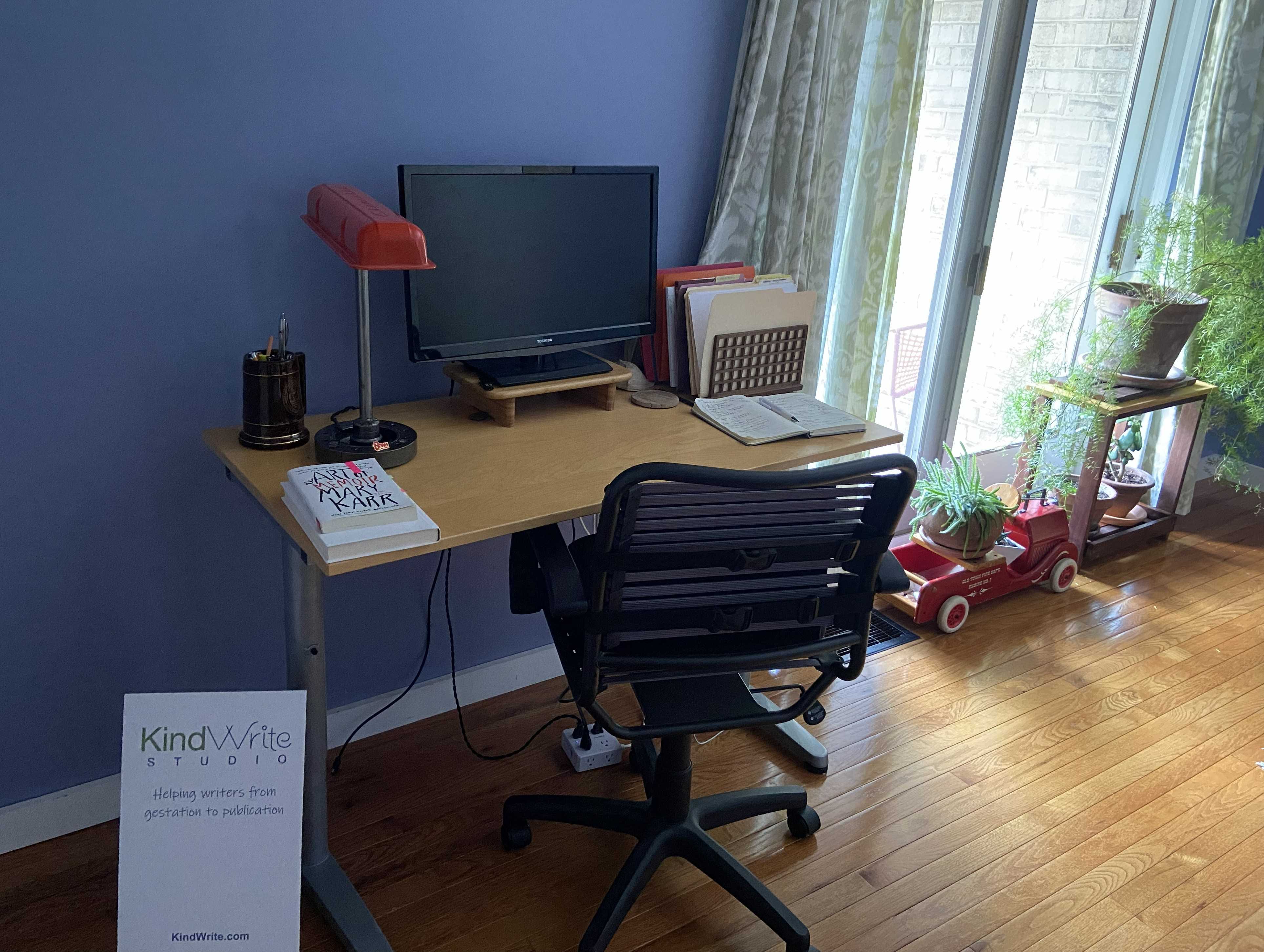
I can’t stress enough how important it is to design a good space in which to write. Think about whether you like to spread out at the dining room table. Or whether you can place a desk in a nook–cozy or vibrant, whatever vibe works. A lot of writers do well to establish a space blocked out for the creativity to happen, a spot entirely for the work, to help put yourself in both the literal physical space as well as the figurative writing space.
Once you’ve identified your best spot, what do you want within arm’s reach? A shelf? A filing cabinet? Do you want to organize your materials in a pencil holder, your files and notebooks in a drawer? In your space, do you want to add potted plants? Colorful artwork?
One of my favorite tools is a bamboo desktop file holder. It has a lattice pattern separating the compartments, which I think looks cool as well as reminds me what each section contains. My son bought it for me, knowing I view this space as sacred. (Actually, I went online and picked it and sent the link to my son).
Here’s what appeals to Sybil Van Antwerp, the protagonist of the novel, The Correspondent. “I sit down at my desk with a stack of the letter writing paper and the pens I like. My desk faces a small window toward the river and there are honeysuckle bushes beneath it, which in summer attract hummingbirds. The house will be silent, or if I am feeling passionate, Tchaikovsky or Stravinsky from the CD player.”
Sybil is a character in a novel, which is why she’s so lucky to be placed in a setting with a river and honeysuckle bushes and hummingbirds. While most of us don’t have the benefit of living amid such natural beauty, we can still create our own little edens.

At a recent writing retreat, a groundhog fueled my work. In the early afternoon, it would appear outside my window, ambling about a stone wall with crevices big enough for it to slip in and out. I’d open my laptop after lunch and keep glancing out, hoping it would appear. Every day, it did. Every day, I wrote alongside my friend.
Establish a writing schedule you can keep
Don’t worry if you haven’t blocked out three hours a day starting in the 4 a.m. hour. While that works for some people, if the writing life becomes too big of a chore, you are likely to feel guilty if you miss a session. Or just cry uncle and give up.
Be realistic, be kind to yourself. The main thing is to establish a habit that works for you then stick to it, whether it’s an hour a day seven days a week, or three hours a week spread across Monday, Thursday and Saturday.
Set small writing goals and deadlines
I sometimes start a first draft when I know I have a meeting or a time-certain stop. I’m forced to write quickly, with only an hour to get a first draft onto the page before I have to log off. Those are the madwoman times, when getting words down against the clock propels my work. I always have a cleanup project when I return to it, but it’s a relief to have sentences to fix rather than face down that blank screen.
The creators of the Pomodoro Technique go so far as to recommend using a timer to block off increments of work. It’s a way to focus on a creative task for a set time – 25- or 50-minute blocks – before taking a scheduled break. That structure, with shorter bursts of uninterrupted work, can add rigor and help conquer empty screen anxiety.
Find accountability to stay motivated
Consider an accountability partner with whom you check in regularly. That partner will want to know whether you wrote the five pages you planned over the weekend, and you won’t want to let that partner down. Writing networks, writing classes, writing coaches, developmental editors, beta readers … seek out people you trust to comment upon and encourage your work. While you’re at it, check in with us at KindWrite Studio! We’d love to hear what you’re working on and how we can help.
Final thoughts
Developing a routine and sticking to it is an important part of being a writer. At the same time, flexibility is key. Maybe writing at your desk two hours a day in the morning worked great for a few weeks, but then it got too hot upstairs or your partner started doing yoga with a loud online instructor near your space. Move around. Write at a different time. Get a new view. It's okay to tinker with your routine. Understand that your creative self needs nurturing and listen to what that self is telling you. Then go write!